 Receptnaptár
Ugali (East African stiff maize porridge)
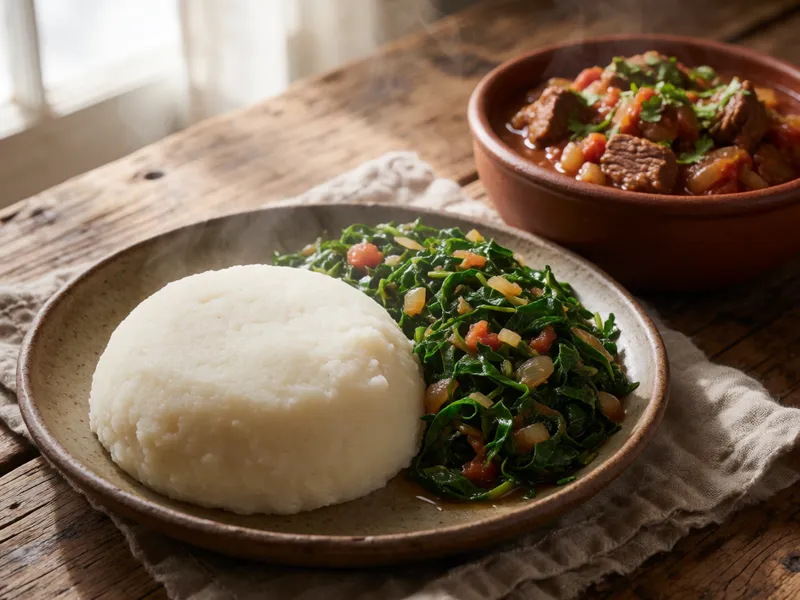
Ugali is the daily bread of Kenya and Tanzania: a stiff, mouldable porridge cooked from white maize flour. It is eaten by hand: you roll a piece into a ball, press a hollow into it with your thumb and use it to scoop up stew or greens. On its own it tastes neutral, which is why it goes with everything.
 Open in Receptnaptár — serving calculator, cook mode, save
Ingredients
Method
Tap a step once you've finished it.
- Bring the water and salt to the boil in a heavy pot.
- Whisk a third of the maize flour into the boiling water and cook for 1 minute, until you have a thin porridge.
- Lower the heat to medium and work in the remaining flour in two batches with a wooden spoon; the mixture thickens quickly.
- Cook for 6-8 minutes, stirring and pressing it against the side of the pot, until it forms a dense, smooth ball that pulls away from the pot.
- Cover and steam over the lowest heat for 5 more minutes to cook out the raw flour taste.
- Turn out into a wet bowl or onto a plate, shape into a dome with a wet spoon, and serve sliced or torn by hand.
A Receptnaptár original recipe. Calories and protein are estimated.
Tips
- Good ugali is firm and not sticky: if it is soft, cook it longer or add a little more flour.
- Keep stirring and pressing throughout, or it stays lumpy.
- The crust left in the pot comes off easily after 10 minutes of soaking.
- Leftovers can be sliced and fried in a little oil for breakfast the next day.
Frequently asked questions
What is ugali eaten with?
Sukuma wiki (braised greens), nyama choma (grilled meat) and bean or fish stews; never on its own.
Can I use yellow cornmeal?
You can, but the taste and colour will be those of polenta; East African ugali is made from white maize.
🌱 Vegetarian and vegan recipes: more recipes like this
Similar recipes
- Cheese polenta dumpling · Hungarian
- Mchadi (Georgian corn flatbread) · Middle East & Caucasus
- Makki di roti (Indian cornmeal flatbread) · Indian
- Lahoh (Somali-Yemeni spongy pancake bread) · African
- Boerewors with pap and sous (South African spiced sausage with tomato and onion gravy) · African
- Homemade Corn Tortillas · Mexican
More african ideas
- Jollof rice (West African spiced tomato rice)
- Moroccan couscous with vegetable and meat ragout
- Egusi soup (West African pumpkin-seed soup)
- Bunny chow (South African curry in a hollowed-out loaf)
- Chakalaka (South African spiced vegetable relish)
- Nkatenkwan (Ghanaian groundnut soup with chicken)
- West African okra soup with beef and prawns
- Moroccan chicken soup with vermicelli and saffron (chorba)
How to use it · Privacy · Legal notice · Editorial principles · About us · Cookie settings