 Receptnaptár
Injera (Ethiopian tangy, spongy teff flatbread)
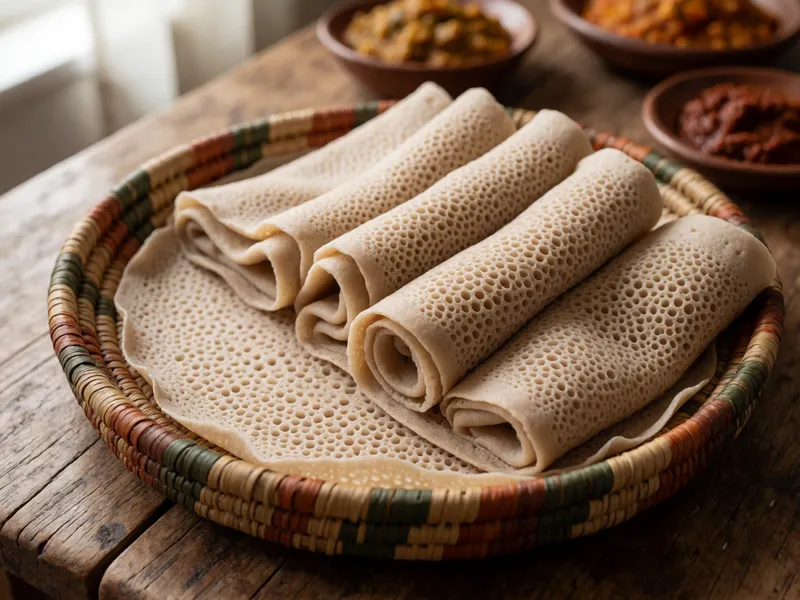
Injera is bread, plate and cutlery in one in Ethiopia and Eritrea: a large, spongy, tangy flatbread on which the stews are piled and which is torn off to eat them. It is made from teff, a tiny-grained, gluten-free ancient cereal, and several days of fermentation give it its characteristic flavour. It is cooked on one side only, and the porous top soaks up the sauce.
 Open in Receptnaptár — serving calculator, cook mode, save
Ingredients
Method
Tap a step once you've finished it.
- Whisk the teff flour, yeast and lukewarm water in a large bowl until smooth, cover with a cloth and ferment at room temperature for 2 days (1 day in a warm kitchen), until bubbly and sour-smelling.
- Carefully pour off the dark liquid that has gathered on top, salt the batter and thin it with water to the consistency of pancake batter.
- Heat a 26-28 cm non-stick frying pan with a lid over medium heat and wipe it thinly with oiled kitchen paper.
- Pour a ladle of batter into the centre and quickly swirl the pan to spread it thinly.
- When small holes ('eyes') appear all over the surface, after about 30 seconds, cover and steam for 2-3 minutes, until the edges curl up; do not turn it.
- Slide onto a cloth and stack only when cool, or they stick together.
A Receptnaptár original recipe. Calories and protein are estimated.
Tips
- Teff flour is sold in health food shops and online; mixed half and half with wheat flour it is easier to cook, but no longer gluten-free.
- The longer it ferments, the more sour it gets: a day and a half is enough the first time.
- The pan must not be too hot: if the batter sets at once you cannot spread it and no holes form.
- Keep back some batter (ersho) as a starter for the next batch, which then ferments without yeast.
Frequently asked questions
What does injera taste like?
Mildly sour, like sourdough bread, and slightly earthy; the texture is soft and spongy, like a thick pancake.
How is it eaten?
One large injera lines the platter with the stews on top; more is served rolled up, and you tear off pieces to pinch up the food.
🌱 Vegan (estimated): more vegan and vegetarian recipes
Similar recipes
- Piadina (thin Italian flatbread, filled) · Italian
- Chapati (East African layered flatbread) · African
- Chapati (Indian whole-wheat flatbread) · Indian
- Crumpets (English spongy pocked griddle cakes) · British
- Lepinja (Serbian yeasted flatbread) · South Slavic
- Tattie scone (Scottish potato griddle scone) · British
More african ideas
- Jollof rice (West African spiced tomato rice)
- Moroccan couscous with vegetable and meat ragout
- Egusi soup (West African pumpkin-seed soup)
- Bunny chow (South African curry in a hollowed-out loaf)
- Chakalaka (South African spiced vegetable relish)
- Nkatenkwan (Ghanaian groundnut soup with chicken)
- West African okra soup with beef and prawns
- Moroccan chicken soup with vermicelli and saffron (chorba)
How to use it · Privacy · Legal notice · Editorial principles · About us · Cookie settings