 Receptnaptár
Homemade orange marmalade (Seville orange marmalade)
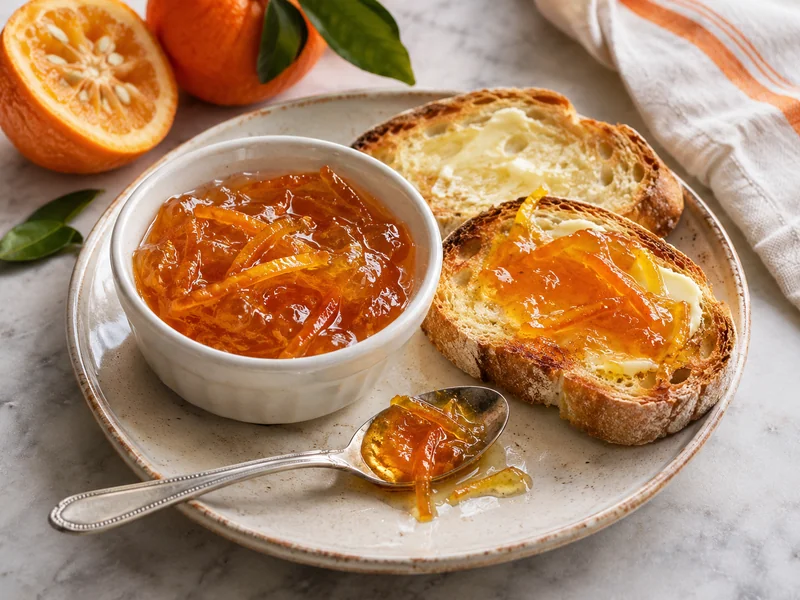
Orange marmalade is an indispensable part of the British breakfast: a characteristically bittersweet preserve cooked from bitter Seville oranges with their peel, on buttered toast. Its season is January-February, when Seville oranges are available. Homemade marmalade is glossy, golden, and its flavour is more intense than shop-bought.
 Open in Receptnaptár — serving calculator, cook mode, save
Ingredients
Method
Tap a step once you've finished it.
- Wash the oranges, halve them and squeeze the juice into a large pot; put the pips and white pith into a muslin bag (the source of pectin) and add it to the pot.
- Slice the orange peel into thin strips, add it to the pot with the water and lemon juice; leave overnight.
- Next day bring the mixture to a boil and simmer over low heat for 1.5-2 hours until the peel is completely soft and the liquid has reduced by about half.
- Remove the muslin bag and squeeze out the pectin-rich liquid into the marmalade.
- Add the sugar, stir over low heat until dissolved, then boil hard for 15-20 minutes until setting point (105 C, or a drop on a cold plate wrinkles).
- Pour the hot marmalade into sterilised, warm jars, seal, and store in a cool place; serve on toast with butter.
A Receptnaptár original recipe. Calories and protein are estimated.
Tips
- Seville oranges have a short season, but the peel can be frozen.
- The pips and pith are the source of pectin: do not throw them out.
- Check setting point with a cold plate.
- In sterilised jars in a dark, cool place it keeps a year.
Frequently asked questions
Instead of Seville oranges?
It can be made from ordinary oranges, but they have less pectin so more lemon juice is needed.
Why bitter?
Seville oranges are bitter, which gives the marmalade its character.
🌱 Vegan (estimated): more vegan and vegetarian recipes
Similar recipes
- Homemade cranberry sauce (for Christmas turkey) · British
- Orange salad · Hungarian
- Pork Ribs in Orange Glaze (costela de porco ao molho de laranja) · Spanish & Portuguese
- Orange chicken · Chinese
- Flambéed Picanha in Orange Sauce (picanha flambada ao molho de laranja) · Spanish & Portuguese
- Warm Cumberland Sauce · Hungarian
More british ideas
- Full English breakfast
- Kedgeree (Anglo-Indian smoked fish rice with egg)
- Bubble and squeak (English fried leftover potato and cabbage)
- Hot cross buns (English spiced Easter buns marked with a cross)
- Crumpets (English spongy pocked griddle cakes)
- Bacon butty (English bacon sandwich in a roll)
- Porridge (Scottish porridge with salt or honey)
- Kippers (English smoked herring with butter, lemon and toast)
How to use it · Privacy · Legal notice · Editorial principles · About us · Cookie settings