 Receptnaptár
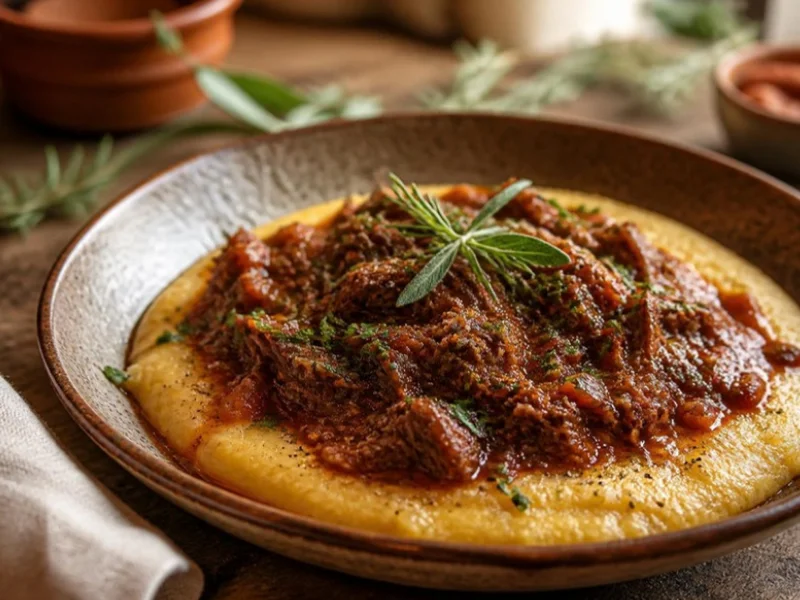
Polenta con ragù di cinghiale (polenta with wild boar ragù)
Polenta con ragù di cinghiale is a winter dish from Tuscany and Umbria: wild boar ragù cooked slowly in wine and tomato, served on creamy polenta. Long cooking, little attention — the strong flavour of the game mellows slowly.
 Open in Receptnaptár — serving calculator, cook mode, save
Ingredients
Method
Tap a step once you've finished it.
- Pat the meat cubes dry, season with salt and pepper. In a large, heavy pot brown them in the oil in batches over high heat, then transfer to a plate.
- In the fat left in the pot, fry the onions, carrots, celery and garlic for 8-10 minutes until soft and lightly golden.
- Pour in the wine, scrape up the browned bits from the bottom and boil until reduced by half.
- Add the hand-crushed tomatoes, juniper, bay leaves and rosemary, and return the meat. Cook covered over very low heat (or in a 160°C oven) for 2.5-3 hours until the meat practically falls apart. Add a little water if needed.
- For the polenta, bring the water to the boil with the salt. Whisking constantly, pour in the cornmeal in a thin stream and cook over low heat, stirring often, for 40-45 minutes until creamy and pulling away from the sides of the pot. At the end stir in the butter and Parmesan.
- Remove the bay leaves and rosemary from the ragù. Pile the polenta onto plates and ladle plenty of wild boar ragù over it.
A Receptnaptár original recipe. Calories and protein are estimated.
Tips
- Cook the game low and slow so it becomes tender; wild boar is fibrous and tough, and turns silky after about 3 hours.
- Juniper berries bring out the gamey flavour nicely, but do not use many — they are strong and slightly bitter.
- Stir the polenta often, otherwise it becomes lumpy and catches; quick-cook polenta takes less time.
- The ragù is even better the next day, and it can be frozen.
Frequently asked questions
What can replace wild boar?
Venison or pork shoulder also works, but the flavour of wild boar is more distinctive.
Should I add chocolate?
In some regions a cube or two of dark chocolate is stirred into the ragù at the end, which adds depth; it can be left out.
Similar recipes
- Wildgulasch (game goulash with red wine and lingonberries) · German
- Wildschweinbraten (roast wild boar with red wine gravy and cranberries) · German
- Venison stew with lingonberries (Siberian game dish) · Russian
- Wild boar stew with pine nuts · Russian
- Rabbit stew (nyúlpörkölt) · Hungarian
- Garlic Rabbit (Conejo al ajillo) · Spanish & Portuguese
More italian ideas
- Spaghetti alla carbonara
- Risotto ai funghi (mushroom risotto)
- Ossobuco alla milanese
- Melanzane alla parmigiana (aubergine parmigiana)
- Saltimbocca alla romana
- Lasagne al forno
- Tagliatelle al ragù bolognese
- Cacio e pepe
How to use it · Privacy (in Hungarian) · Legal notice (in Hungarian) · Editorial principles (in Hungarian) · Cookie settings