 Receptnaptár
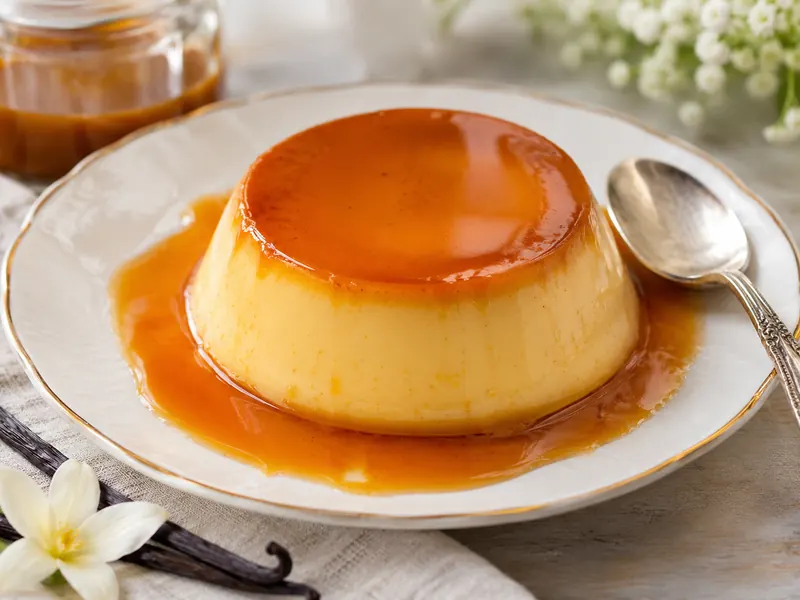
Crème renversée au caramel (caramel custard, crème caramel)
Crème renversée, 'inverted cream', is the basis of the French egg and milk dessert: made of eggs, milk and sugar, baked in a bain-marie and turned out covered in caramel. In Escoffier's 1903 cookbook the basic proportions are 200 g sugar, 4 whole eggs and 8 yolks per litre; our version is scaled for a smaller batch and is just as rich and silky.
 Open in Receptnaptár — serving calculator, cook mode, save
Ingredients
Method
Tap a step once you've finished it.
- Bring the milk to the boil with the split vanilla pod, remove from the heat and leave to infuse for 10 minutes.
- For the caramel, cook the 80 g sugar with the water in a small pot, without stirring, to a golden brown and pour at once into four 150 ml moulds or small dishes, tilting them so that a thin layer covers the base and sides.
- Whisk the eggs and yolks with the 100 g sugar and the salt (not to a foam) and gradually stir in the lukewarm milk.
- Strain the mixture through a sieve and divide among the moulds.
- Stand the moulds in a deep tray of water (the water reaching halfway up) and bake in a 150 degree oven for 35-40 minutes until the centre is still slightly wobbly.
- Cool, then cover and chill for at least 4 hours; to serve, run a knife around the edge and turn out onto plates.
Based on: Auguste Escoffier: Le Guide culinaire (1903) (a classic French cookbook), modernised. Calories and protein are estimated.
Tips
- The water bath protects the custard from too much heat, so it does not get holes and bubbles.
- Do not let the caramel get too dark or it turns bitter, and pour it into the moulds at once while hot.
- On chilling the custard sets and the caramel melts into a sauce: that is why at least 4 hours of resting is needed.
Frequently asked questions
What is the difference between crème caramel and crème brûlée?
Crème caramel is milk-based, with fewer yolks, with caramel sauce on top; brûlée is cream-based, with more yolks and a crisp caramel crust.
How long does it keep?
In the fridge, covered, for 3 days; the caramel keeps melting so it becomes even saucier.
🌱 Vegetarian and vegan recipes: more recipes like this
Similar recipes
- Crème anglaise (French vanilla custard sauce) · French
- Dulce de leche (South American caramelised milk spread) · Spanish & Portuguese
- Cream-ppang (Korean vanilla custard-filled bun) · Korean
- Leche flan (thick caramel custard) · Southeast Asian
- Gyeran-pudding (Korean egg caramel pudding) · Korean
- Flan pâtissier sans pâte (crustless vanilla flan) · French
More french ideas
- Clafoutis aux abricots (apricot almond clafoutis)
- Crumble pommes-poires à l'avoine (apple and pear oat crumble)
- Compote pommes-rhubarbe (vanilla apple and rhubarb compote)
- Soufflé au fromage blanc et citron (lemon curd cheese soufflé)
- Tarte au citron light (lemon tart with oat base and lighter curd)
- Gâteau de semoule light (semolina pudding cake with raisins)
- Île flottante light (lighter floating islands)
- Flognarde aux pommes (Limousin baked apple batter pudding)
How to use it · Privacy · Legal notice · Editorial principles · About us · Cookie settings