 Receptnaptár
Carnival doughnuts (farsangi fánk)
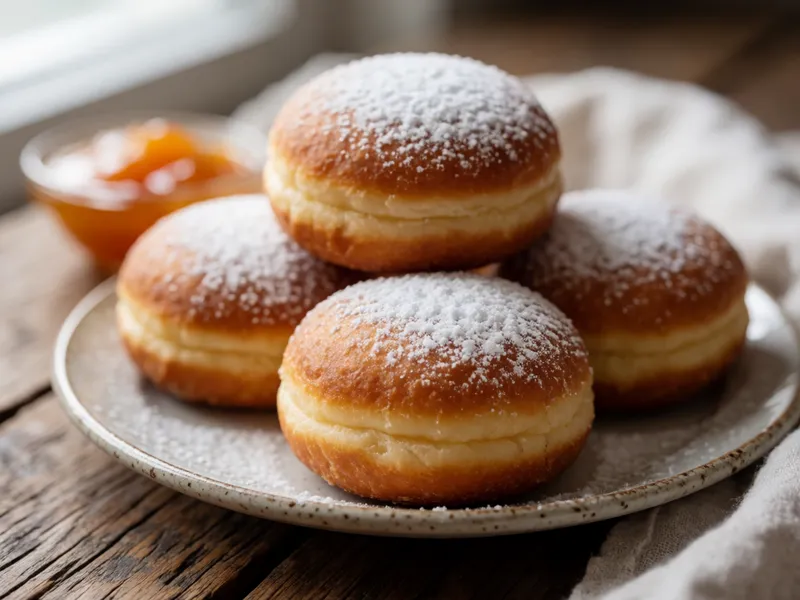
Farsangi fánk, the Hungarian carnival doughnut, is the best-known sweet of the Hungarian winter: its yeast dough is light and fluffy, with a pale ribbon running around its middle. In January and February it is fried in almost every family, but it is delicious at any time. The ribbon comes from frying under a lid and from well-risen dough. It is at its best with apricot jam and icing sugar.
 Open in Receptnaptár — serving calculator, cook mode, save
Ingredients
Method
Tap a step once you've finished it.
- Melt the butter over low heat or in the microwave and let it cool slightly.
- Dissolve the yeast in the lukewarm milk with a pinch of sugar and leave for 10 minutes until it starts to foam.
- In a cup, mix the risen yeasty milk with the egg yolks and the melted butter.
- In a large bowl, mix the flour, salt and sugar, then pour in the liquid mixture. Work it thoroughly with a wooden spoon or your hands until you get an elastic but firm dough - it should be slightly stiffer rather than too soft.
- Cover with a tea towel and leave to rise in a warm place for about 45-60 minutes, until doubled in size.
- Turn out onto a floured work surface, flatten with your palms to about 2 cm thick, then cut out rounds with a doughnut cutter or a glass.
- Place the doughnuts on a floured tea towel, cover, and leave to rise again for 30-40 minutes, until almost doubled.
- Heat the oil/lard to 170°C. Place the doughnuts risen-side down into the fat, cover with a lid, and fry for 2-3 minutes until the bottom is golden. Flip and fry the other side uncovered for another 2-3 minutes until golden.
- Lift out with a slotted spoon, drain on paper towels, and while still warm, dust generously with icing sugar.
Based on: Malatinszky Fanny szakácskönyve (a classic Hungarian cookbook), modernised. Calories and protein are estimated.
Tips
- Always keep the fat at around 170 °C, because if it is too hot the doughnuts burn outside and stay raw inside, and if it is too cool they soak up fat.
- Put only 3-4 doughnuts in the fat at a time, because they keep swelling as they fry, and this way the temperature of the fat does not drop too far.
- Leave space between the doughnuts as they rise, and lightly flour the tea towel, so that the dough is easy to lift.
Frequently asked questions
Why did my doughnuts not get a ribbon?
Usually the dough did not rise enough, or the lid was missing at the start of frying. The doughnuts should float, sitting half submerged in the fat. Dough that is too crowded or too flat will not lift.
Can they be filled with jam before frying?
It is better to add it after frying: serve it alongside the doughnut, or pipe it inside with a small syringe or piping bag. Before frying, the jam would burn, and the dough would not rise properly either.
Similar recipes
- Choux fritters (toló-fánk) · Hungarian
- "Shaggy" choux puffs (borzas fánk) · Hungarian
- Chimney cake dough (dorongfánk) · Hungarian
- Bavyrsak (Tatar fried dough balls) · Russian
- Buñuelos Navideños (Crispy Fritters with Cinnamon Sugar) · Mexican
- Sour cream doughnuts · Hungarian
More hungarian ideas
- Oat curd cheese dumplings with cinnamon oats and yogurt
- Baked pear and ginger oatmeal squares
- Chocolate banana curd cheese cups
- Rhubarb yogurt crumble cake
- Light lemon yogurt mug cake
- Light sour cherry sponge with oat flour
- Lighter poppy seed bread pudding (mákos guba) with oat milk
- Vanilla kifli dipped in chocolate
How to use it · Privacy (in Hungarian) · Legal notice (in Hungarian) · Editorial principles (in Hungarian) · Cookie settings