 Receptnaptár
Kuglóf (Kugelhupf)
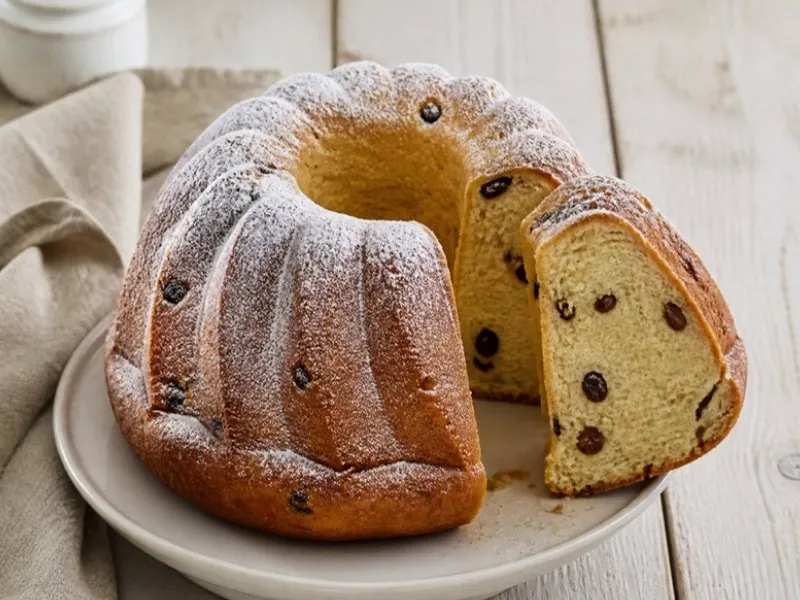
Kuglóf, the kugelhopf of Central Europe, is the Sunday cake of the Austro-Hungarian Monarchy: baked in a tall, fluted mould and offered with coffee or for breakfast. This yeasted version with raisins gives a soft, fluffy crumb, in the manner of the old bourgeois kitchens. Butter, egg yolks and a little patience are the whole secret. Serve it dusted with icing sugar.
 Open in Receptnaptár — serving calculator, cook mode, save
Ingredients
Method
Tap a step once you've finished it.
- Beat the butter, sugar and salt together with the egg yolks until fluffy.
- Dissolve the yeast in the lukewarm milk.
- Pour the yeasted milk into the butter mixture, add the flour and work it thoroughly with a spoon. It should be a light, thick batter.
- Stir in the raisins.
- Pour into a buttered Kugelhupf tin dusted with breadcrumbs, filling it only halfway.
- Cover and let rise in a warm place for about 45-60 minutes, until it reaches the top of the tin.
- Bake in an oven at 160 °C (140 °C in a fan oven) for about 45 minutes.
Based on: Malatinszky Fanny szakácskönyve (a classic Hungarian cookbook), modernised. Calories and protein are estimated.
Tips
- Butter every flute of the mould thoroughly and dust it with breadcrumbs, or the kuglóf will stick and its pattern will be damaged.
- Toss the raisins in a little flour before mixing them into the dough, so that they do not sink to the bottom of the mould and are spread evenly.
- Leave the finished kuglóf in the mould for 10 minutes, then turn it out onto a rack, because it is fragile while piping hot, but it can stick to the mould once completely cold.
Frequently asked questions
Can it be made with baking powder?
Yes, but that gives a stirred kuglóf, with a denser, more cake-like texture. Yeast is what makes this dough truly fluffy, so it is worth taking the time for the rising.
How do you make a marbled kuglóf?
Mix 2 tablespoons of cocoa into a third of the dough, and spoon the light and dark doughs alternately into the mould. In that case the raisins can be left out.
Similar recipes
- Hefezopf (buttery braided yeast bread with jam) · German
- Brioche-style sweet loaf (kalács) dough · Hungarian
- Graz-style kuglóf · Hungarian
- Concha (Mexican Shell-Topped Sweet Bread) · Mexican
- Magdalenas (Spanish Milk and Oil Muffins) · Spanish & Portuguese
- Miller's rolls · Hungarian
More hungarian ideas
- Scrambled eggs with sausage and tomato
- Semolina pudding with honey and cinnamon (tejbegríz)
- Pancakes with sweet curd cheese (túrós palacsinta)
- Bread and dripping with red onion (zsíros kenyér)
- Eggy bread with cinnamon sugar (bundáskenyér)
- Ham and cheese omelette
- Cocoa swirl buns (kakaós csiga)
- Porridge with fruit and honey
How to use it · Privacy (in Hungarian) · Legal notice (in Hungarian) · Editorial principles (in Hungarian) · Cookie settings