 Receptnaptár
Breaded veal cutlet (Wiener schnitzel)
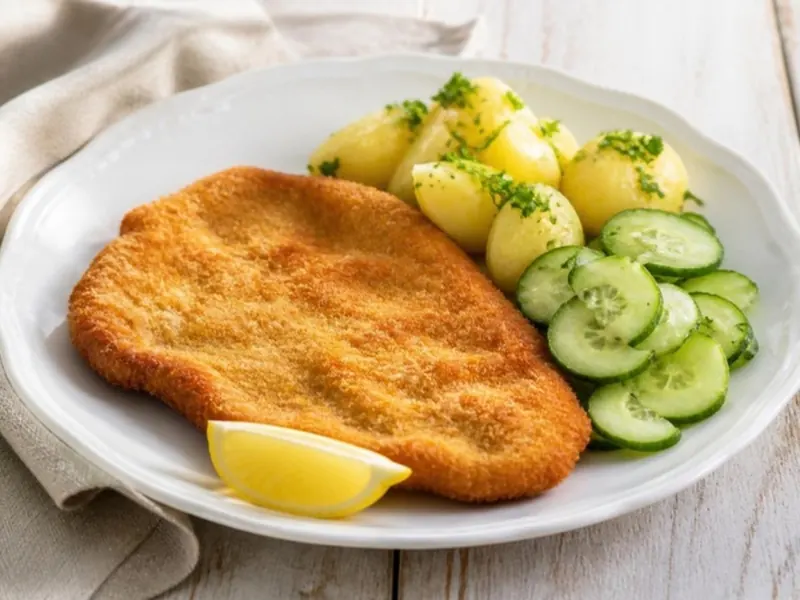
A true Wiener schnitzel gets a light, airy coating that "puffs up" away from the meat — this takes thinly pounded veal and plenty of hot fat.
 Open in Receptnaptár — serving calculator, cook mode, save
Ingredients
Method
Tap a step once you've finished it.
- Trim all the membranes off the meat, wash it, then pound it evenly with a meat mallet to about half a centimetre thick.
- Season both sides with salt and leave for 15-20 minutes.
- Set out three plates: flour in one, beaten egg (mixed with a pinch of salt) in another and breadcrumbs in the third.
- Coat each piece of meat first in flour, then in egg and finally in breadcrumbs, making sure it's evenly covered everywhere.
- Heat enough oil in a large frying pan over medium-high heat to cover the bottom about 1 cm deep.
- Fry the breaded cutlets for 2-3 minutes on one side, then 2-3 minutes on the other, until nicely golden but not dry.
- Blot off the excess fat with kitchen paper.
- Serve with lemon slices and mashed potatoes or parsley potatoes.
Based on: A jó házikonyha (a classic Hungarian cookbook), modernised. Calories and protein are estimated.
Tips
- Pound the meat evenly to about half a centimetre thick — a thicker cutlet burns on the coating before the inside is cooked through.
- After breading, don't press the crumbs on firmly — tradition says they should sit loosely, so they separate from the meat and "puff up" while frying.
- Fry in plenty of hot fat so the cutlet almost floats in it — this helps create the even, airy coating.
- Serve with lemon at once, hot — the coating goes soft if it sits.
Frequently asked questions
What's the difference between Wiener schnitzel and a regular breaded cutlet?
Wiener schnitzel is traditionally made from veal, with a thinner, looser coating; the pork-based breaded cutlet uses thicker meat with the crumbs pressed on more firmly.
Can pork loin replace the veal?
Yes, but technically you'd then get a regular breaded cutlet instead of a Wiener schnitzel — it differs in flavour and texture, but can be made the same way.
Similar recipes
- Breaded (Panéed) Veal Cutlet · Hungarian
- Wiener Schnitzel (Viennese cutlet of veal or pork loin, with lemon) · German
- Escalope milanaise à la française (French-style breaded veal escalope) · French
- Osso buco alla milanese (Milanese braised veal shank) · Italian
- Cordon bleu (breaded escalope stuffed with cheese and ham) · German
- Ossobuco alla milanese · Italian
More hungarian ideas
- Lecsó with sausage
- Hortobágy meat pancakes
- Layered potato bake (rakott krumpli)
- Creamy potato stew with frankfurters (krumplifőzelék)
- Creamy green bean stew with meat patties
- Fried breaded cheese with mashed potatoes and tartare sauce
- Pasta bake with ham and egg
- Cold supper platter with cold cuts and cheese
How to use it · Privacy (in Hungarian) · Legal notice (in Hungarian) · Editorial principles (in Hungarian) · Cookie settings