 Receptnaptár
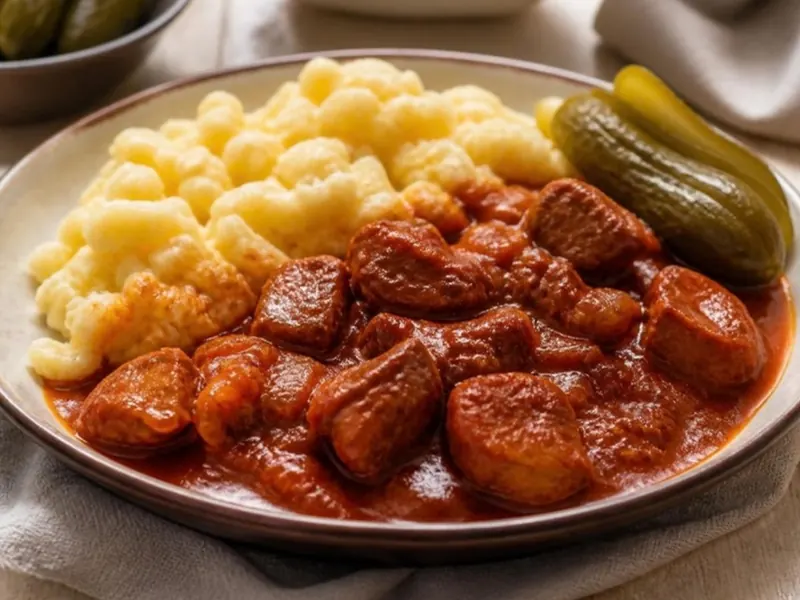
Pork stew (sertéspörkölt)
The secret to a good pork stew isn't the seasoning but the order of steps: how the paprika is heated and how slowly it braises decide whether you get a thick, velvety sauce or a thin, bitter one.
 Open in Receptnaptár — serving calculator, cook mode, save
Ingredients
Method
Tap a step once you've finished it.
- Cut the pork into 3x3 cm cubes.
- Soften the finely chopped onion in the lard over medium heat for 8-10 minutes until translucent but not browned.
- Take the pan off the heat and stir in the paprika so it doesn't burn.
- Immediately add the meat to stop the paprika cooking.
- Return to the heat, season with salt and stir for a few minutes until the meat turns white.
- Add 100 ml of water, cover and simmer over low heat for 60-70 minutes, stirring now and then and topping up with water as needed.
- It's ready when the meat crushes easily with a fork and the sauce is thick and slightly glossy with fat.
- For the last 10 minutes, leave it uncovered so the sauce thickens.
- Serve hot, with nokedli dumplings, pasta or potatoes.
Based on: A jó házikonyha (a classic Hungarian cookbook), modernised. Calories and protein are estimated.
Tips
- Always stir the paprika into the onions off the heat, then push the meat straight back on — in hot fat, paprika can burn and turn bitter within seconds.
- Don't rush the braising: slow cooking over low heat lets the onion melt into a thick, saucy base, which gives pörkölt its characteristic texture.
- Only top up with as much water as has boiled away — pörkölt isn't a soup, the sauce should stay thick and cling to the meat.
- Freezes well, and tastes even better the next day as the flavours meld; reheat gently over low heat with a splash of water.
Frequently asked questions
What's the difference between pörkölt and gulyás (goulash)?
Pörkölt is a thick, low-liquid meat dish served with a side; gulyás is a thinner, soupier dish with vegetables that's eaten on its own.
Why does my pörkölt taste bitter?
Almost always burnt paprika — paprika should never be added directly into hot fat still on the heat.
Similar recipes
- Polish-style pork goulash · Polish
- Sauté de porc aux pruneaux (pork stew with prunes) · French
- Chicos (Pork Stew with Dried Corn) · Mexican
- Potato pancakes topped with pork stew (placek po węgiersku) · Polish
- Chile verde con puerco (green chile pork stew) · Mexican
- Silesian dumplings with stew gravy and cucumber salad · Polish
More hungarian ideas
- Chicken stew (csirkepörkölt)
- Rabbit stew (nyúlpörkölt)
- Mushroom Hash (Ragout)
- Fish Hash (Ragout)
- Veal Hash (Ragout) in Pastry Shells
- Pork Stew with Thick Noodles (Serbian-Style Dish)
- Rabbit Hash (Ragout) with Fried Eggs
- Pork Kidney with Brain
How to use it · Privacy (in Hungarian) · Legal notice (in Hungarian) · Editorial principles (in Hungarian) · Cookie settings