 Receptnaptár
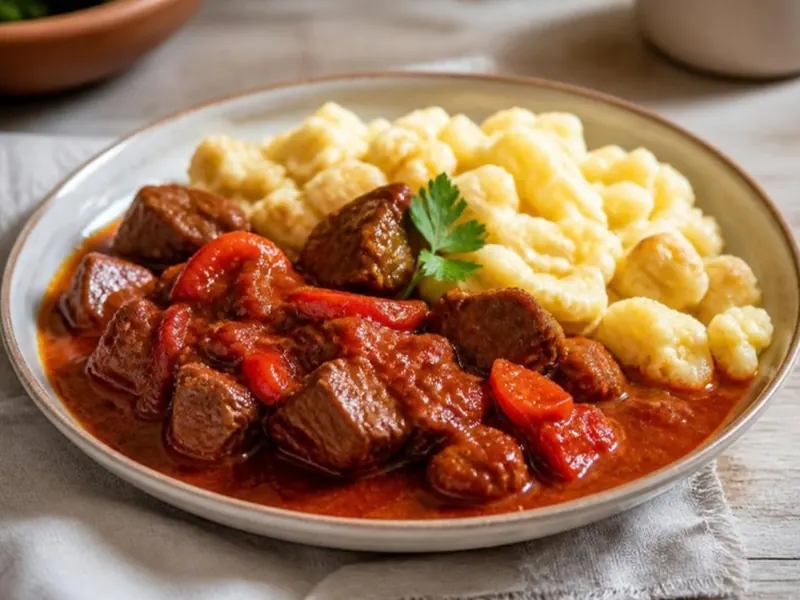
Balkan beef goulash with dumplings (gulaš)
Gulaš is the Balkan descendant of Hungarian gulyás, which spread through the region in the days of the Austro-Hungarian Monarchy and took on a flavour of its own. It combines slowly braised beef, plenty of caramelised onions, paprika and a little caraway. It is thicker than Hungarian gulyás soup and in fact a close relative of pörkölt, the Hungarian stew. Serve it with small dumplings or potatoes; on cold days nothing beats it.
 Open in Receptnaptár — serving calculator, cook mode, save
Ingredients
Method
Tap a step once you've finished it.
- Heat the oil or lard in a large, heavy pot over medium heat.
- Add the onion and fry for 8-10 minutes, stirring often, until it caramelises to a deep gold - this gives the gulaš its deep flavour, so don't rush it.
- Add the beef and brown it on all sides over higher heat for 6-8 minutes until it has a nice brown crust.
- Take off the heat, stir in the paprika, garlic and caraway, then immediately add a little water so the paprika doesn't burn.
- Add the pepper and tomato and season with salt and pepper.
- Pour in enough water to just cover the meat, bring to the boil, then cover and simmer gently over low heat for 2-2.5 hours.
- Check the liquid level every hour and top up with hot water if needed - the meat is done when it falls apart easily with a fork.
- For a thicker sauce, cook uncovered for the last 20 minutes so it reduces.
- Serve with freshly cooked dumplings or potatoes, with a little paprika sprinkled on top.
A Receptnaptár original recipe. Calories and protein are estimated.
Tips
- Do not rush the onions: cooked slowly to a golden colour over 8-10 minutes, they give the sauce its sweet, deep flavour.
- Beef shin is best, because the connective tissue turns to gelatine during the long braising and thickens the sauce naturally.
- Add the paprika off the heat and pour in a little water straight away, because in hot fat it turns bitter in a matter of seconds.
Frequently asked questions
How does it differ from Hungarian pörkölt?
It is similar, but the Balkan version often includes garlic, caraway and more vegetables, and the onions are browned to a darker colour. The sauce is slightly thinner than in a traditional pörkölt.
Can I add wine?
Yes, 100-200 ml of red wine at the start of the braising adds a great deal. It is common in Dalmatian and Bosnian cooking too, and goes especially well with beef.
Similar recipes
- Ropa vieja (Cuban shredded beef in pepper sauce) · Spanish & Portuguese
- Goulash soup (gulyásleves) · Hungarian
- Deutsche Gulaschsuppe (German goulash soup) · German
- Mexican beef stew with olives and raisins (estofado) · Mexican
- Stifado (beef stew with pearl onions) · Greek
- Green chile beef stew · Mexican
More south slavic ideas
- Goveđa čorba (beef soup with root vegetables)
- Krompir paprikaš (Serbian potato paprikash with sausage)
- Riblji paprikaš (paprika hake stew)
- Bamija (Balkan lamb and okra stew)
- Balkan stuffed sauerkraut rolls (sarma)
- Spiced minced meat sausages in flatbread (ćevapčići)
- Spiced bean soup with smoked meat (pasulj)
- Đuveč - baked vegetable rice with chicken
How to use it · Privacy (in Hungarian) · Legal notice (in Hungarian) · Editorial principles (in Hungarian) · Cookie settings